Be Ready for the Master's Return
Be Ready for the Master's Return
Elke Speliopoulos
3/19/202612 min read
Luke 12:32-40
Our Father, who art in heaven, hallowed be Thy name. Thy kingdom come, Thy will be done on earth as it is in heaven. Give us this day our daily bread, and forgive us our sins and debts as we forgive our debtors. Lead us not into temptation, but deliver us from evil. For Thine is the kingdom and the power and the glory forever and ever. Amen.
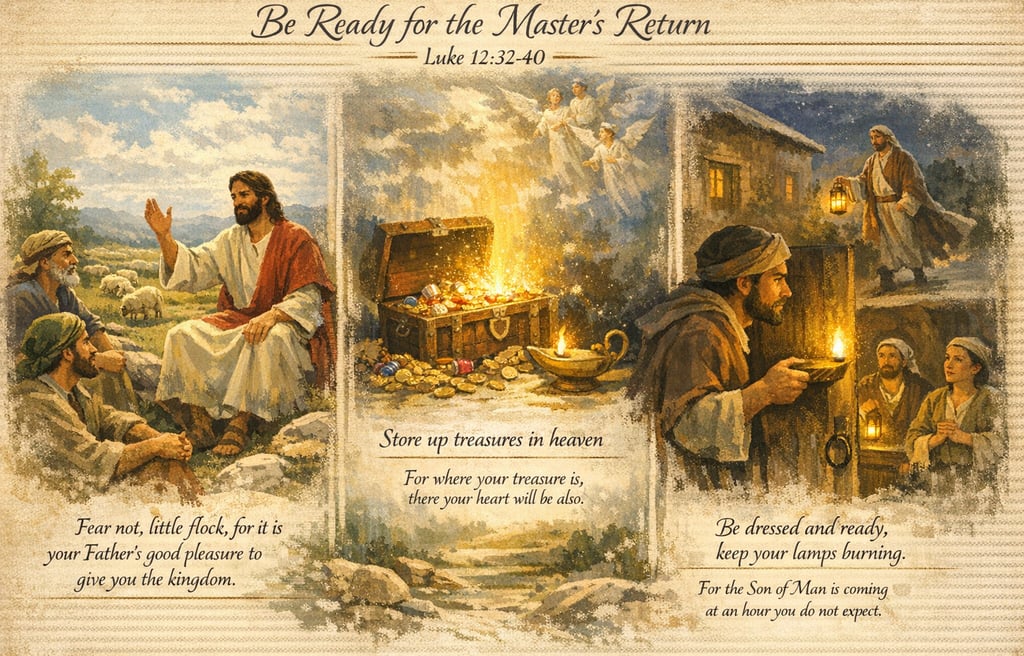
Tonight we are reflecting on Luke 12, the Gospel reading appointed for this coming Sunday. It is a very meaningful passage because it speaks to the Christian life in this world, especially as we look toward the second coming of Christ. The reading begins at Luke 12:32 and continues through verse 40. Our Lord says, “Do not be afraid, little flock, for your Father desires to give you the kingdom. Sell your possessions and give alms. Make for yourselves purses that do not wear out, and a treasure in heaven that does not fail, where no thief comes near and no moth corrupts. For where your treasure is, there your heart will be also.” Then He continues, “Keep your belt tied around your waist and your lamps lit. Be like people waiting for the time when their master will return from the wedding feast, so that when he comes and knocks, they open the door for him immediately. Blessed are those servants who will be found watching when their master comes. Truly, I tell you, he will tie his belt around his waist, make them sit down to eat, go around and serve them. And if he comes and finds them ready in the middle of the night or just before dawn, blessed are those servants. But know this, if the master of the house knew the time of night at which the thief was coming, he would stay awake and not let his house be broken into. Therefore, you also be ready, because the Son of Man is coming at the very hour you do not expect.” Glory be to God for His Word.
This reading begins in the middle of a larger section. Just before this, Christ has been teaching His disciples not to worry about their lives—what they will eat, what they will wear, or how they will provide for themselves. He points to the ravens, which God feeds, and to the lilies of the field, which are clothed more beautifully than Solomon in all his glory. In other words, if God cares for birds and flowers, how much more will He care for His own people? Then Christ gives the key instruction: “Seek God’s kingdom, and all these things will be added to you.” That is the context of the verses we are reading tonight. He is not speaking in isolation. He is continuing a lesson about trust, detachment from anxiety, and confidence in the Father’s care.
When Christ says, “Do not be afraid, little flock,” He is using the familiar image of sheep and shepherd. A flock is a group of sheep, and throughout the Gospels Jesus presents Himself as the Good Shepherd. The sheep hear His voice and follow Him. So when He calls the disciples a “little flock,” He is reminding them that they belong to Him, that He watches over them, and that they are safe under His care. Then He says something astonishing: “Your Father desires to give you the kingdom.” Not part of the kingdom. Not half the kingdom. The kingdom. In the Old Testament, earthly kings would sometimes say, “Ask what you will, even up to half my kingdom.” But here God does not speak like an earthly king. He desires to give His people the fullness of His kingdom, all that is good, eternal, glorious, and life-giving. That is why they do not need to live in fear.
Christ then says, “Sell your possessions and give alms.” This does not mean that every Christian is required to live in absolute poverty, but it does mean that we are not to cling to our possessions as though they were our security or our life. Throughout Scripture, God teaches His people to be generous, merciful, and open-handed. Giving alms can include money, but it is not limited to money. It can mean feeding someone who is hungry, cooking for someone who is sick, helping a family in need, visiting those in prison, or encouraging those who are forgotten. All of these are works of mercy. In the language of stewardship, we often speak of time, talent, and treasure. Treasure refers to the material resources God has given us. Time refers to how we spend the hours of our lives. Talent refers to the gifts and abilities God has entrusted to us. All three belong to Him, and all three can be used to serve the kingdom. One person teaches, another sings, another serves in the altar, another helps children, another gives financially, and another offers hidden acts of kindness. All of these are ways of storing treasure in heaven.
That is why Christ says, “Make for yourselves purses that do not wear out, and a treasure in heaven that does not fail.” In the ancient world, people kept money in leather pouches tied to their belts. Those could wear out, tear, or be stolen. Christ uses that familiar image to teach a spiritual truth. Earthly wealth is temporary. It can be lost, stolen, devalued, or destroyed. Even in our own day, money can disappear through market failure, theft, illness, or disaster. But heavenly treasure cannot be taken away. No thief can reach it, and no moth can corrupt it. Then comes the penetrating statement: “Where your treasure is, there your heart will be also.” In other words, what we value most reveals where our heart truly lives. If our deepest investment is in earthly things, then our heart remains bound to anxiety, fear, and passing concerns. But if our treasure is in the kingdom of God, then our heart is drawn upward toward what is eternal.
This calls us to ask where and how we are serving Christ in this world. The point is not merely to reject material things, but to make sure that our life is oriented toward the kingdom. I was reminded of a quote from St. Gregory the Theologian, who warned against thinking that deeds of mercy are optional. He said that he himself once thought such acts were merely voluntary, but then he became alarmed when he considered the goats who were placed on the left hand, not because they had stolen or committed some obvious crime, but because they had failed to minister to Christ among the poor. That takes us directly to the Lord’s teaching about the sheep and the goats. What separated them was not outward religious appearance, but whether they had fed the hungry, clothed the naked, and visited the imprisoned. When the goats ask, “When did we fail to do these things for You?” Christ answers, “If you did not do it to the least of these, you did not do it to Me.” That is what it means to build treasure in heaven. It means seeking Christ in the poor, the suffering, the forgotten, and the needy. It means focusing on the things of God and asking where we may serve Him in this world.
After speaking about treasure, Christ turns to another image: readiness. He says, “Keep your belt tied around your waist and your lamps lit.” The Bible often teaches us about being ready. We think, for example, of the parable of the ten virgins. Some were wise and brought extra oil for their lamps; others were foolish and were not prepared. When the bridegroom came, the wise were ready and entered in, while the foolish were left outside. The image of the belt tied around the waist also recalls the Israelites on the night of the Exodus. God told them to be dressed and ready to leave Egypt at once when His command came. They were not to delay. In the same way, Christ is telling His disciples—and us—to live in a state of readiness, not spiritual laziness.
He then says, “Be like people waiting for the time when their master will return from the wedding feast, so that when he comes and knocks, they open the door for him immediately.” The master in this passage is Christ Himself. The wedding feast points to the eternal joy of the kingdom of God. Scripture often uses the image of a banquet, a feast, or a wedding celebration to describe the life of the age to come. The prophet Isaiah speaks of the Lord preparing a feast for all peoples, a feast with rich food and well-aged wine. This is the image of eternal communion, joy, and fulfillment in God’s presence. Christ is saying that we are to live as those waiting for that reality, ready to open immediately when He comes.
What is especially beautiful is what Christ says next: “Blessed are those servants who will be found watching when their master comes. Truly, I tell you, he will tie his belt around his waist, make them sit down to eat, go around and serve them.” This is a remarkable image. The Lord of all becomes the servant of those who remained faithful and watchful. It shows His joy in receiving those who waited for Him with love and perseverance. Then He adds that whether He comes in the middle of the night or just before dawn, blessed are those servants if He finds them ready. This means that even sleep should not symbolize carelessness in our spiritual life. We do not know the moment, and therefore we must live in such a way that we are always ready. Even in the small rhythms of life, this can shape our habits. If we wake in the night, we can offer a brief prayer. If we rise in the morning, we can begin with prayer. If we pause during the day, we can remember Christ. Readiness is not panic; it is steady faithfulness.
Christ then uses another picture: “If the master of the house knew the time of night at which the thief was coming, he would stay awake and not let his house be broken into.” Here the emphasis is not on fear, but on vigilance. If we knew exactly when danger would come, we would prepare carefully. We would lock the doors, secure the house, and remain watchful. But the point is that we do not know the hour. Therefore Christ says, “You also be ready, because the Son of Man is coming at the very hour you do not expect.” This brings us to the second coming of Christ, a theme that many Christians do not hear often enough in church. Some Protestant groups focus intensely on newspaper events and current affairs, trying to calculate how close the end may be. But that is not how the Church teaches us to live. We are not told to decode every headline. We are told to be ready, watchful, faithful, and rooted in Christ.
So what do we know about Christ’s return? First, it will be public and glorious. It will not be hidden or secret. Scripture says it will be like lightning flashing from east to west. When Christ came the first time, He came in humility, as a child born of the Virgin Mary, laid in a manger, clothed in meekness. But when He comes again, He will return as the King of kings, in unveiled majesty. He will come as the Pantocrator, the Ruler of all. That means that if anyone claims, “I am Christ,” or if rumors arise about secret appearances, we are to ignore them. When Christ truly returns, all will know it. It will be unmistakable.
Second, the resurrection will be bodily. The fathers of the Church insist upon this. The same body that is buried will be raised, though transformed in glory. Scripture uses the image of a seed being sown in the ground and then rising in a different form. Our present body is not yet the resurrection body. It is subject to weakness, sickness, aging, and death. But when Christ returns, all will be raised. The dead—both righteous and unrighteous—will stand before Him. We do not know whether Christ will return in our lifetime or long after we have died, but we do know that death is not the end. We will be raised.
Third, the judgment will be real, and it will reveal all things. Revelation 20 speaks of the great white throne, of the dead standing before God, and of books being opened. The dead are judged according to their works. That means there will be a moment when all things are brought to light—our deeds, our words, our thoughts, the orientation of our hearts, and whether or not we trusted Christ and sought His kingdom. Whether this will be experienced as a public unveiling or a personal encounter with Christ, we do not know fully, but nothing will remain hidden. That truth should sober us, not to drive us into despair, but to call us into repentance and seriousness.
Because of all this, the proper Christian response is watchfulness. The Syriac fathers speak often of vigilance. To keep the lamp burning means to live in repentance, prayer, mercy, and faithfulness. It means living ethically, according to the teaching of the Gospel, not waiting for a last-minute spiritual correction. We should not become obsessed with trying to predict dates or signs. Christ can come tonight, or He can come long after we are gone. Nothing must happen first to “unlock” His return. Therefore our concern must not be speculation, but relationship. We are to worry less about the timing and more about whether our hearts are ready for Him.
There is also great comfort in the second coming. It is not only a moment of judgment, but also a moment of justice. Those who have done evil and oppressed others will answer before Christ. Those who have suffered for righteousness will be vindicated. For communities that have experienced persecution, exile, suffering, or the loss of loved ones for the faith, this is a source of hope. Christ will set all things right. The oppressed will not be forgotten. The faithful dead will not remain in the grave forever. The wrongs of history will not remain unanswered. So the return of Christ is not merely a frightening doctrine; it is also a promise of restoration, truth, and hope.
There are several practical questions we should ask ourselves from this passage. First, when Christ says, “Do not be afraid, little flock,” what fears keep us from trusting that the Father truly desires to give us the kingdom? Often the problem is that we judge ourselves too harshly and assume we are beyond God’s mercy. But the Christian life is not about never falling. It is about always rising again, repenting, and continuing to follow Christ. Second, when Christ says, “Where your treasure is, there your heart will be also,” we should ask what our weekly schedule would reveal about us. Does it show that we make time for prayer, for Scripture, for acts of mercy, for church, and for spiritual growth? Or does it show that our treasure is elsewhere? Third, when Christ says, “Keep your lamps burning,” we should ask whether there are things we know we ought to do for the Lord, but have postponed. If Christ returned tonight, what unfinished obedience would we regret?
The fathers of the Church help illuminate this passage beautifully. St. Ephrem the Syrian says that Christ came the first time in a body in which He suffered, but He will come again clothed in glory and majesty. In other words, He will still be recognizable as the same Christ, but now revealed openly as the reigning King. Ephrem also says that like lightning His sign will appear in heaven, and suddenly the Judge will be revealed. The book shall be opened before the Judge, the hidden things disclosed, and the body that was buried will rise again clothed in glory. He reminds us that what is now weak and corruptible will be raised incorruptible. He also urges us to be watchful in prayer, so that when Christ comes, He may find us awake. That is a practical challenge to all of us. If we do not pause to pray even once in a day, then how are we cultivating relationship with Christ? Prayer need not always be long. It can be the Lord’s Prayer. It can be the Jesus Prayer: “Lord Jesus Christ, Son of God, have mercy on me, a sinner.” It can be a brief prayer before meals, in the morning, in the night, or whenever we remember Him.
St. Cyril of Alexandria says that Christ calls them a little flock not only because they are few, but because they are sheep in the midst of wolves. Yet the Father is still pleased to give them the kingdom. Cyril also teaches that when the mind is fixed on what is above and the desire is directed heavenward, the heart will dwell there as well. That means if we want our hearts to be aligned with Christ, we must deliberately keep our minds and desires turned toward Him. The Jesus Prayer is one powerful way of doing that throughout the day. St. Jacob of Serugh says that suddenly the King will be revealed from heaven and the righteous will rejoice at His appearing. He reminds us that this will not be something hidden or easily missed. All will know. The books will be opened before all peoples, and the secrets of every heart will be made manifest. He also warns us to keep the oil of mercy in our lamps, lest we be shut outside like the foolish virgins. That means our Christian life must be marked by mercy, kindness, respect, and compassion. He says further that the dust shall hear His voice and rise, and the graves shall give back what they received. Before the fearful throne of the Judge, no one will be able to hide.
So what can we learn from all of this? First, trust the Father. Even if we feel like a little flock in a world that seems hostile or indifferent to Christ, the Father is pleased to give us the kingdom. It is not about numbers, status, or worldly influence. It is about belonging to Christ. Second, your treasure reveals your heart. What you invest in—your time, your energy, your attention—will shape who you become. If you anchor yourself in worldly attachments alone, your heart will remain anxious and unstable. But if your treasure is heavenly, your heart becomes free. Third, stay spiritually awake. Christ calls us to be ready, not through panic, but through faithful daily living—prayer, mercy, forgiveness, service, repentance, and attentiveness to Him. This is not something to postpone until the end of life. A life with Christ is not only the path to eternal life; it is also the truest, steadiest, and most meaningful way to live now.
So let us remain awake. Let us read the Scriptures, for they are our guide to life. Let us pray, even in small ways throughout the day. Let us repent when we fall and rise again. Let us store treasure in heaven through mercy and faithfulness. Christ is coming; that much is certain. And the same Christ who is coming in glory is the One who now says to us, “Do not be afraid, little flock, for your Father desires to give you the kingdom.”
Contact
Reach out for spiritual guidance or questions
Email : vicar@stpetersphoenix.org
© 2025. All rights reserved.