One Day We Will Stand before Christ
One Day We Will Stand before Christ
Elke Speliopoulos
3/18/202613 min read
. Let us start with prayer. In the name of the Father, and of the Son, and of the Holy Spirit. Our Father, who art in heaven, hallowed be Thy name. Thy kingdom come, Thy will be done on earth as it is in heaven. Give us this day our daily bread and forgive us our sins and debts as we forgive those who are our debtors. Forgive me, as I usually pray this slightly differently. For Thine is the kingdom and the power and the glory forever and ever. Amen. In the Greek Orthodox Church, where my husband and I worship, the wording is, “forgive us our trespasses as we forgive those who trespass against us,” and in the Syriac translation into English, the sequence is slightly different, which I sometimes struggle to recall exactly.
For tonight, I decided not to revisit the Gospel passage for the coming Sunday, since we already covered it last year, and there is a recording available on our YouTube channel for those who would like to revisit it. That Gospel is the wedding at Cana, where our Lord, together with the Virgin Mary, attends a wedding feast. When the wine runs out, the Mother of God intercedes, and though Christ says, “My time has not yet come,” He nevertheless transforms water into wine—indeed, into the finest wine—revealing His glory. Instead of returning to that passage, I thought it would be more beneficial for us to reflect on Romans 14:1–12, a passage written by St. Paul, one of the most theologically rich yet deeply practical books of the New Testament. This passage is especially fitting as we approach the beginning of the Great Fast, the holy Ṣawmō Rabbo, which begins on Monday.
St. Paul, in this section, speaks about not judging one another. He begins by saying that we are to receive those who are weak in faith without quarrelling over opinions. Some believe they may eat anything, while others, being more cautious, eat only vegetables. Yet the one who eats must not despise the one who abstains, and the one who abstains must not judge the one who eats, for God has accepted both. This teaching becomes very relevant when we look around us today. Across different Christian traditions, and even beyond Christianity, we see that many communities are entering into fasting at nearly the same time. The Coptic Orthodox Church has already begun the Great Fast. The Catholic Church marked the beginning of Lent with Ash Wednesday, where ashes are placed on the forehead as a sign of repentance. The Muslim community has begun Ramadan. In the Greek Orthodox tradition, there is a preparatory period called Meatfare Week, followed by Cheesefare Week, gradually leading into the full fast. In our own Syriac tradition, we enter fully into the fast on Clean Monday. Thus, while the forms and disciplines differ, all are moving toward a season of repentance and devotion.
In our home, following the guidance of my spiritual father, I begin fasting alongside my husband according to the Greek Orthodox preparation, abstaining from meat during this week while still partaking of dairy and fish, before entering into the fuller fast. This shows how traditions can differ even within the same household, yet remain united in purpose. St. Paul’s teaching reminds us that such differences should not become grounds for pride or judgment. If one fasts more strictly, it is unto the Lord; if another follows a different discipline, that too is unto the Lord. God receives both. Therefore, there is no place for boasting, nor for looking down upon others.
St. Paul continues by asking, “Who are you to judge another’s servant?” Each person stands or falls before their own master. This can also be understood in the context of spiritual guidance. For example, my spiritual father has given me a particular discipline—such as performing prostrations during prayer—to prepare for Lent. This is given for my spiritual growth, not as a universal rule for everyone. Others may have different guidance from their own spiritual authorities. Therefore, what one person practices should not become a measure by which others are judged. Each person must be firm in their own conviction, guided by the Holy Spirit and by the authority placed over them.
He further explains that whether one observes a particular day or treats all days alike, whether one eats or abstains, all is done for the Lord. This again reflects the diversity of traditions we see, even among Orthodox churches, where different liturgical emphases and readings exist. Though there was a historical division between the Syriac and Greek traditions, we can still recognize that both direct the faithful toward Christ. The external forms may differ, but the orientation of the heart remains the same.
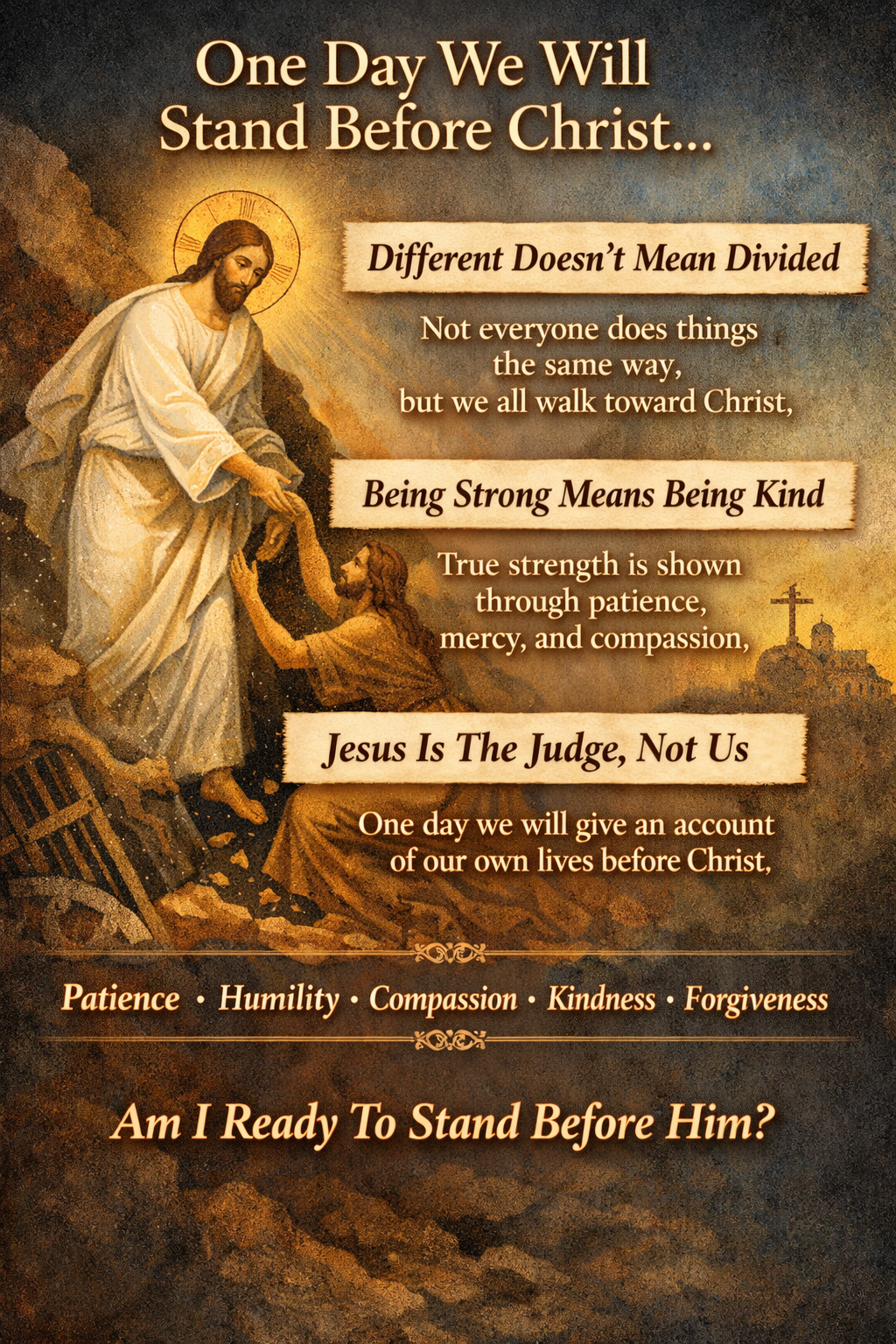
St. Paul then brings us to the central truth: “None of us lives to himself, and none of us dies to himself. If we live, we live to the Lord, and if we die, we die to the Lord.” Our entire existence—life and death—is oriented toward God. This leads into the profound statement that Christ died and rose again to become Lord of both the dead and the living. Here we see a key distinction between Western and Eastern theological emphasis. In much of Western theology, the focus is on Christ paying a debt for sin. In the Orthodox understanding, however, the emphasis is on healing and restoration—Christ conquering death itself. Humanity is not merely guilty, but wounded, inclined toward sin. Christ enters into our condition, takes on our mortality, and through His death and resurrection destroys death, liberating those who were held captive. The imagery often seen in Orthodox iconography of the Resurrection shows Christ descending into Sheol, breaking its gates, and raising Adam and Eve—demonstrating that salvation is not simply a legal transaction, but a victorious act of divine life overcoming death.
Because of this, all will stand before Him. As St. Paul says, every knee will bow and every tongue will confess. Each person will give an account before the judgment seat of Christ. Therefore, it is neither appropriate nor necessary for us to judge one another now, since all judgment ultimately belongs to God. Instead, we are called to humility and self-examination.
This brings us to a practical reflection. We may ask ourselves: have we judged others within the Church for doing things differently? It is easy to fall into this. For example, I personally struggle when I see people arriving late to the Holy Qurbono, perhaps even during the homily or later, and still coming forward for communion. I feel a tendency toward judgment, thinking that we should all participate fully from the beginning. Others may judge based on attire, behavior, or other external factors. Yet St. Paul reminds us that such judgments are not ours to make. Each person is seeking Christ in their own way, and it is God who guides, corrects, and perfects. Our task is not to measure others, but to turn inward, repent, and grow in love.
If God sees something wrong in a person’s behavior, then it is God who must work upon that person’s heart, not us. It is not our task; it is above our pay grade. That leads to the second question: when I disagree with another Christian, do I react with pride or with patience? If someone shares something that seems completely wrong to us, or holds an opinion that we find surprising for a Christian, we must be very careful. It is not ours to correct in a spirit of judgment or superiority. Rather, we must allow God to work in that person’s life. Indeed, it may even be that they are right and we are wrong. For that reason, patience must always guide our response to others. Then there is the third question: if I truly remembered that one day I will stand before Jesus Christ, what would I change about the way I treat others? That is a sobering thought. Imagine going to sleep tonight and, at three o’clock in the morning, Christ returns. Suddenly, we are standing before Him, giving an account of our lives. Would there be moments we would regret—times when we could have shown more kindness, more compassion, more courtesy, more humility, more gentleness? These are the things we should reflect upon as we consider this passage.
From there, we turn to Ṣawmō Rabbo, the Great Lent fast, or simply the Great Fast. As I mentioned, we begin on Monday. Sunday is the last day that we in the Syriac Church eat normally, even though some traditions have already begun fasting. For us, Monday marks the start of this forty-day journey of repentance. That is the heart of it. I read something recently that struck me deeply: as we develop an Orthodox mindset and draw nearer to Christ, the closer we come to Him, the more aware we become of our own need for His forgiveness. That is why repentance becomes so central during this season. We are preparing ourselves for the Resurrection, for the joy of Easter, and we do so through repentance, prayer, humility, and self-examination. We ask ourselves where we have failed, what we have done that does not please God, and how we may return more fully to Him. Fasting is certainly one part of this, because it is called the Great Fast, but it is far more than abstaining from food. It is also fasting from sinful behaviors, fasting from pride, fasting from contempt toward others, giving alms to the poor, reading the Scriptures, and turning our attention more firmly toward Christ. Ṣawmō Rabbo is about much more than what we place on our plates.
According to one explanation I read on the archdiocesan page, the traditional discipline of the Great Fast was not to eat or drink until three o’clock in the afternoon, and only then to eat vegan, plant-based food. For many people in the working world, that may not be possible. In such a case, it is perfectly appropriate to speak with one’s priest and receive a more suitable rule—perhaps fasting until noon, or perhaps abstaining from meat, dairy, and eggs while still eating in a manageable way. Whatever discipline one adopts, it should be something consciously offered to the Lord. I would strongly encourage everyone to take this seriously. We are Orthodox Christians, and fasting is part of our inheritance. It is worth thinking practically as well: when I am tempted to eat a hamburger, what can I substitute instead? Perhaps a plant-based burger, or a falafel sandwich. But even more importantly, during that moment, can I also pause and ask where I have failed the Lord and what in my heart needs healing? That inner examination is a major part of the Great Fast.
The Great Lent fast is not concerned only with our bodies, although our bodies are indeed disciplined through abstinence from meat, dairy, and eggs. The fast is also about the heart. Are we angry with people? Do we judge them? Are we prideful? Sin is everywhere. Sometimes half the battle begins the moment we wake up, when our thoughts are already disordered or irritated. Yet the purpose of the fast is not punishment. God does not seek to punish us. He seeks to purify us, to bring us back into alignment with Him, and to teach us to see others through His eyes rather than through our selfishness. Thus the fast asks not only whether we are controlling our appetite, but also whether we are willing to help those in need, whether we are meditating on God during the day, whether our prayer life should be increased, and whether we are becoming more attentive to His presence. Finally, the fast is communal. It is not a private diet. Even if one person slips one day and eats something they should not, the Church as a whole continues to carry that person along. The next day they resume. This is a corporate, spiritual struggle, not an individual performance.
Scripture is full of fasting. In both the Old and New Testaments, people fast whenever they seek the Lord, desire His guidance, or grow in their dependence upon Him. Our Lord Himself fasted for forty days in the wilderness. Moses fasted forty days on Mount Sinai before receiving the commandments. This makes fasting not an optional curiosity, but a deeply biblical and sacred pattern. When others ask us why we cannot eat a hamburger, we should be ready to answer that fasting is part of our spiritual struggle as a church, a way of preparing ourselves together for the joy of Easter, as we journey toward the Resurrection of Christ. In my husband’s church, for example, they observe the fast very intensely. There are liturgies and services throughout the week, and on Wednesday evenings there is often a communal Lenten meal after the service. It is beautiful because the community shares the discipline and the joy together. Then on Easter Saturday night, the whole church gathers around eleven or a little later. The church is dark. After the prayers, the priest lights a candle from the one flame on the altar, and that light is passed from person to person until the entire church is filled with the light of Christ. Then comes the Divine Liturgy, Holy Communion, and only afterward, deep into the night, the priest blesses baskets of meat, eggs, cheese, wine, and sweets, and the whole congregation breaks the fast together. I must admit that during the high feast of Easter I often go with my husband, so I have not fully experienced Easter in the Syriac Orthodox Church apart from the foot-washing service, but what I am trying to emphasize is the communal beauty of this season. It is a church-wide struggle. There are longer liturgies, penitential prayers, prostrations, and many acts of devotion. This is something we do together.
Turning to the Church Fathers, St. Clement of Alexandria, who died in the year 215, wrote that we are not meant to abstain from different foods absolutely, but rather not to be preoccupied with them. That is striking. The problem is not food itself, but our attachment to it. He says that we should eat what is set before us out of respect to our host. That also means that if during Lent you are invited to the home of a non-Orthodox friend and they serve pizza with meat and cheese, you should accept it graciously. One should not offend the host or behave in a self-righteous manner. The spirit of Lent is not arrogance. We are to keep the fast ourselves, but if food is offered to us in love, we may receive it with gratitude and continue our struggle the next day.
St. John Chrysostom, who died in 407, explains that St. Paul is not saying that the one who eats should simply ignore the one who abstains, nor that the one who abstains should never be corrected. Rather, he means that the stronger person must not despise the weaker, and the one who abstains must not judge the one who eats. Thus, if during the fast one of our brothers or sisters has a chicken sandwich, we are not to look down on them. They remain part of the community, and perhaps through the witness of the community they will return more fully to the discipline. Chrysostom further says that the reason we do not judge is not because the behavior is always above criticism, but because the person belongs to God, not to us. It is God’s place to decide how to deal with them. He also reminds us that Christ cares for the dead and therefore certainly cares for the living. Nothing escapes His lordship. If Christ laid down His life for our salvation, then clearly we are of immense value to Him.
St. Irenaeus of Lyons, who died in 202, also comments on this by saying that Christ lived, died, and rose again so that He might rule over both the living and the dead. This brings to mind the powerful icon of Christ breaking open Sheol and drawing out those who had been held captive there. That is how deeply He loves us: He conquered death by His own death so that we might live. St. Polycarp of Smyrna, who died in 155 and was very close to the apostolic age, teaches that if we ask the Lord to forgive us, then we too must forgive, for all of us will stand before the judgment seat of Christ and give an account of ourselves. That is reason enough to pause when we are tempted to be harsh or unkind. St. Ephrem the Syrian, one of our own great fathers, says that we are not to judge one another because the Son Himself has been appointed Judge. Only the knower of secrets can search out hidden things. We do not know why a person acted the way they did, but Christ knows. He also says that food does not make one righteous, nor does abstinence make one pure, but a pure heart sanctifies both eating and fasting. Again, the point is not the mechanics alone, but the transformation of the heart. St. Cyril of Alexandria teaches that the strong must not wound the conscience of the weak, because love builds up while knowledge alone puffs up. We will all stand before Christ’s tribunal, not to answer for someone else, but for ourselves. St. Jacob of Serugh adds, “Judge not your brother, O frail one, for you also stand in need of mercy.” He wisely says that the strong person who mocks the weak proves himself weaker than both. And St. Philoxenus of Mabbug, another of our Syriac fathers, teaches that the one who fasts must not despise the one who eats, and the one who eats must not condemn the one who fasts, because the Lord is judge of both.
There is also that beautiful Paschal sermon of St. John Chrysostom, read every year in the Greek Orthodox Church on Easter night, which says in essence that whether someone has fasted all fifty days, or only three weeks, or just a few days, or not at all, they should still come and rejoice, because Christ is risen. That is the spirit of the Church. We rejoice together. We mourn together. We struggle together. We do not judge one another because someone did not do everything exactly as we think they should have done. From this passage, then, we can draw several lessons. First, different does not mean divided. Not everyone will practice every aspect of the faith in exactly the same way, and that is all right, so long as we are all walking toward Christ. Second, being strong in faith means being kind. True strength is shown not in superiority, but in patience, mercy, and humility. Third, Jesus is the Judge, not us. One day we will stand before Him, and therefore it is better to focus on our own hearts than on the perceived shortcomings of others.
I say all this knowing very well how hard it is, because I myself am guilty. In confession, one of the things I most often have to admit is that I judged someone again. I judged them because their skirt seemed too short, or because they crossed their legs during the liturgy, or for some other small and foolish thing. Again and again I have to confess it and ask the Lord to forgive me and help me to focus on my own struggle, my own askesis, rather than on someone else’s behavior. There may be reasons why people do what they do. They may never have been taught differently. And perhaps my own behavior is offensive to someone else without me realizing it. So that should humble us.
After all of that, I paused and invited questions. One person asked, “What does askesis mean?” I explained that it is a Greek word meaning “struggle.” When we speak of someone being ascetic, we mean that they embrace certain disciplines to draw nearer to God. This may include constant prayer, fasting, vigils, and bodily discipline. Some of the Desert Fathers lived this in an extraordinary way. St. Anthony the Great and St. Arsenius, for instance, lived in the Egyptian desert and fasted greatly. Even in more recent times, there are those who have embraced a similar life of prayer and renunciation. St. John Chrysostom himself suffered from severe stomach ailments, likely because he fasted so intensely. All of this shows that askesis is the offering of struggle to the Lord. It is not merely about deprivation for its own sake, but about turning one’s whole life toward Christ. Whether that means keeping the fast diligently, deepening one’s prayer life, or learning to imitate Christ’s love, humility, and gentleness, the purpose is the same: to become more and more conformed to Him. That is what askesis means. It is the struggle by which we give up something in order to draw closer to God.
After that explanation, there were no further questions, and so the session concluded. I thanked everyone for being present, wished them a good evening, and brought the gathering to a close.
Contact
Reach out for spiritual guidance or questions
Email : vicar@stpetersphoenix.org
© 2025. All rights reserved.