Pray Without Ceasing
Youth Bible study based on First Thessalonians 5:12-28
Elke Speliopoulos
3/18/202616 min read
Without further delay, let us begin with prayer:
In the name of the Father, and of the Son, and of the Holy Spirit, one true God. Our Father, who art in heaven, hallowed be Thy name. Thy kingdom come, Thy will be done on earth as it is in heaven. Give us this day our daily bread. Forgive us our debts and sins as we forgive our debtors. Lead us not into temptation, but deliver us from the evil one. For Yours is the kingdom, the power, and the glory forever and ever. Amen.
Now, let us turn to the text itself. The passage from First Thessalonians is often titled “Exhortations.” In it, St. Paul writes to the faithful, urging them to recognize those who labor among them and stand before them in the Lord, instructing them. These leaders are to be esteemed with exceptional love because of their work, and the community is called to live in harmony with them. He continues by encouraging believers to correct those who fall into error, uplift the discouraged, support the weak, and practice patience with everyone. He warns against repaying evil for evil, instead urging the pursuit of what is good for one another and for all.
The passage continues with a series of powerful spiritual directives: “Be joyful always, pray without ceasing, and give thanks in everything, for this is God’s will for you in Jesus the Messiah.” He further instructs them not to quench the Spirit or ignore prophecy, but to examine everything carefully, holding fast to what is good and rejecting all forms of evil. The section concludes with a prayer that the God of peace may sanctify them completely—spirit, soul, and body—until the coming of the Lord Jesus Christ, affirming that He who calls them is faithful and will accomplish this.
The final portion of the epistle includes closing greetings. Paul asks for their prayers, encourages them to greet one another with a holy kiss, and urges that the letter be read among all the faithful. He ends with a blessing: “May the grace of our Lord Jesus the Messiah be with you. Amen.”
This is the epistle reading for today. To understand it more deeply, it helps to consider its background—who wrote it, when it was written, where it was sent, and why it was composed.
The author of this letter is St. Paul the Apostle, who is responsible for writing most of the epistles in the New Testament. While a few letters are attributed to other apostles, such as St. Peter, and others like the Book of Hebrews are traditionally attributed to Paul within the Orthodox tradition, Paul remains the primary author of New Testament letters outside the four Gospels. Alongside these epistles, the New Testament concludes with the Book of Revelation, written by St. John, who also authored the three Johannine epistles.
An “epistle” simply means a letter, typically written in a formal style. St. Paul often dictated his letters to a scribe, much like a secretary taking dictation. In some cases, he would personally write the closing lines as a form of authentication. This letter to the Thessalonians was written in collaboration with Silas and Timothy, two of Paul’s close companions in ministry.
The letter is addressed to the Christian community in Thessalonica, a significant trade city in ancient Macedonia, located in present-day northern Greece. Paul wrote this letter from Athens, which we can confirm through historical notes and references in the Book of Acts.
The timing of this letter is particularly important. It was written around AD 50–51, approximately 17 to 18 years after the death and resurrection of Jesus Christ. This makes it one of the earliest writings in the New Testament. During those intervening years, the Church was already active and growing. The apostles had been teaching, establishing communities, and passing down both liturgical practices and doctrinal understanding—much of which was initially transmitted orally rather than in written form.
This context is crucial when addressing the common claim that the Church relies more on tradition than Scripture. In reality, Scripture itself is part of that tradition—the written expression of what had already been lived, taught, and practiced within the Church. Before receiving letters like this one, communities such as Thessalonica were already celebrating the Eucharist, conducting liturgy, and living out the Christian faith based on apostolic teaching.
Paul’s purpose in writing this letter is pastoral and encouraging. The early Christians were facing persecution, particularly from the Roman Empire. Paul himself had once been a persecutor of Christians—known as Saul—until his dramatic encounter with the risen Christ on the road to Damascus. Blinded by this encounter and later healed, he became one of the most influential apostles, dedicating his life to spreading and strengthening the Christian faith.
In this letter, Paul seeks to strengthen the believers in Thessalonica, guide them in moral living, and address questions about the return of Christ. Just prior to this passage, he speaks about the resurrection of the dead and the second coming of Christ, reminding them not to grieve without hope. He assures them that those who have died in Christ will rise first, and that all believers will ultimately be united with the Lord.
Following this teaching, Paul shifts focus in Chapter 5. Rather than speculating about the exact timing of Christ’s return—which he says will come like a thief in the night—he urges them to live faithfully in the present. This includes honoring those who serve within the community.
When Paul says, “recognize those who labor among you and stand before you in the Lord,” he is referring to leaders such as priests and deacons, as well as others who serve the community—choirs, volunteers, and those who contribute in various ways. His instruction is clear: appreciate them, love them, and live in harmony.
This teaching is deeply practical. It calls for intentional gratitude and recognition. Even in our own experience, we may sometimes overlook expressing appreciation. Yet, as Paul emphasizes, acknowledging the labor of others strengthens the unity and love within the community.
Think about our own church life, especially when we gather for meals. There is always a group of people—often the same individuals—who quietly labor behind the scenes. The ladies prepare the food, set up the tables, arrange forks, spoons, napkins, plates, and bowls. Afterward, they clean everything up. Others take out the garbage. All of these individuals are laboring among us. This is exactly what St. Paul is referring to. He is telling us to treat such people with exceptional love—to recognize their service, appreciate it, and honor it.
Moving to verse 14, St. Paul continues: “We entreat you, brothers and sisters, to correct those who fall into error, encourage the downcast, share the burden of the weak, and be patient with all people.” When he speaks about correcting those who fall into error, he is not advocating harshness or condemnation. He is not saying to shame or reject someone. Rather, correction must be done with gentleness and love—guiding someone back with humility and care.
He then says to encourage the downcast. This is deeply practical. Think about moments in our parish life, such as memorial services. Often, we offer a quick word of condolence and move on. Yet the person grieving may still be deeply hurting. This is an opportunity to pause—to offer a kind word, a hug if appropriate, or simply acknowledge their loss in a more meaningful way. Encouragement requires intentional presence.
“Share the burden of the weak” extends this further. When someone is struggling—whether with health, finances, or personal hardship—we are called to stand with them. This may mean practical support, like preparing a meal, or something as simple as a phone call. It is about entering into their difficulty rather than remaining distant.
Then comes a challenging instruction: “Be patient with all people.” This is often difficult. There are times when certain individuals may irritate us, even without clear reason. In such moments, patience does not come naturally. One helpful approach is to take this struggle to prayer: asking the Lord to help us see the other person differently, to recognize what is good in them. Over time, this prayer often changes our perspective. Situations arise where we interact more closely with that person, and our understanding deepens. Patience, then, becomes a cultivated virtue, not an automatic response.
St. Paul continues: “Watch out in case any of you should repay evil for evil. Rather, always pursue what is good for one another and for everyone.” This is a direct call to break cycles of retaliation. If someone offends us, the response is not to return offense, but to pursue what is good—through kindness, restraint, or even prayer when words fail.
He then says, “Be joyful always.” Notably, he does not say “be happy always,” which would be unrealistic. Joy is different. It is rooted in the reality that Christ is our Savior and that we belong to Him. Even in difficult circumstances, this truth provides a foundation for enduring joy.
Next comes the well-known instruction: “Pray without ceasing.” This is not about constant formal prayer, but about cultivating a continual awareness of God. A powerful example of this is found in the monastic tradition, particularly through the Jesus Prayer: “Lord Jesus Christ, have mercy on me.” This simple prayer, repeated throughout the day, keeps the mind anchored in Christ. It becomes a kind of inner rhythm that shapes our thoughts and guards against distraction or negativity. While dedicated times of prayer are valuable, “praying without ceasing” is about integrating prayer into the fabric of daily life—upon waking, throughout the day, and before rest.
St. Paul also instructs: “Give thanks in everything.” This echoes the Gospel account of the ten lepers, where only one returned to give thanks. Gratitude is not conditional on circumstances but is a recognition that all good gifts come from God. Even amid difficulty, thanksgiving aligns our hearts with God’s will.
He then warns: “Do not quench the Spirit.” This can be understood as living in a way that restricts the work of the Holy Spirit within us. When we act with anger, hostility, or persistent sin, we create barriers that hinder the Spirit’s activity. Conversely, when we strive for purity, kindness, and humility, we allow the Spirit to work through us—making Christ visible in our interactions with others.
“Do not ignore prophecy” is another important instruction. While prophecy can involve foretelling future events, it more often refers to proclaiming truth. In this sense, Paul is urging believers not to disregard the truth that has been revealed and taught within the Church. It is a call to uphold and live out that truth faithfully.
He continues: “Examine everything; cling to what is good.” This requires discernment. In everyday choices—such as entertainment, relationships, or activities—we are called to evaluate whether something is beneficial or spiritually harmful. What is good should be embraced; what is harmful should be rejected.
This leads directly into the next command: “Flee from everything that is evil.” This is more than passive avoidance—it is active separation. Whether in friendships, environments, or behaviors, we are to distance ourselves from influences that corrupt or lead us away from God.
Paul then offers a prayer: “May the God of peace sanctify all of you perfectly, and maintain the purity of your whole spirit, soul, and body until the coming of our Lord Jesus Christ.” To be sanctified means to be made holy. This is not something we accomplish alone. As Paul concludes, “He who called you is faithful, and He will accomplish it.” This is a crucial theological point: while we strive to live rightly, it is ultimately Christ who works within us, giving us the strength to grow in holiness.
In the closing lines, Paul humbly asks, “Brothers and sisters, pray for us.” Despite his authority and direct encounter with Christ, he still depends on the prayers of others. This underscores the importance of mutual intercession within the Church. If Paul himself sought prayer, how much more should we pray for our priests, deacons, and all who serve?
He also says, “Greet all the brothers and sisters with a holy kiss.” While this specific cultural expression may differ today, its essence continues in practices like sharing peace during the liturgy. It is a sign of unity and reconciliation within the community.
Finally, he urges that the letter be read to all, emphasizing that these teachings are meant for the entire Church. He concludes with a blessing: “May the grace of our Lord Jesus Christ be with you. Amen.”
“Do you all have any questions on this? No? All right.
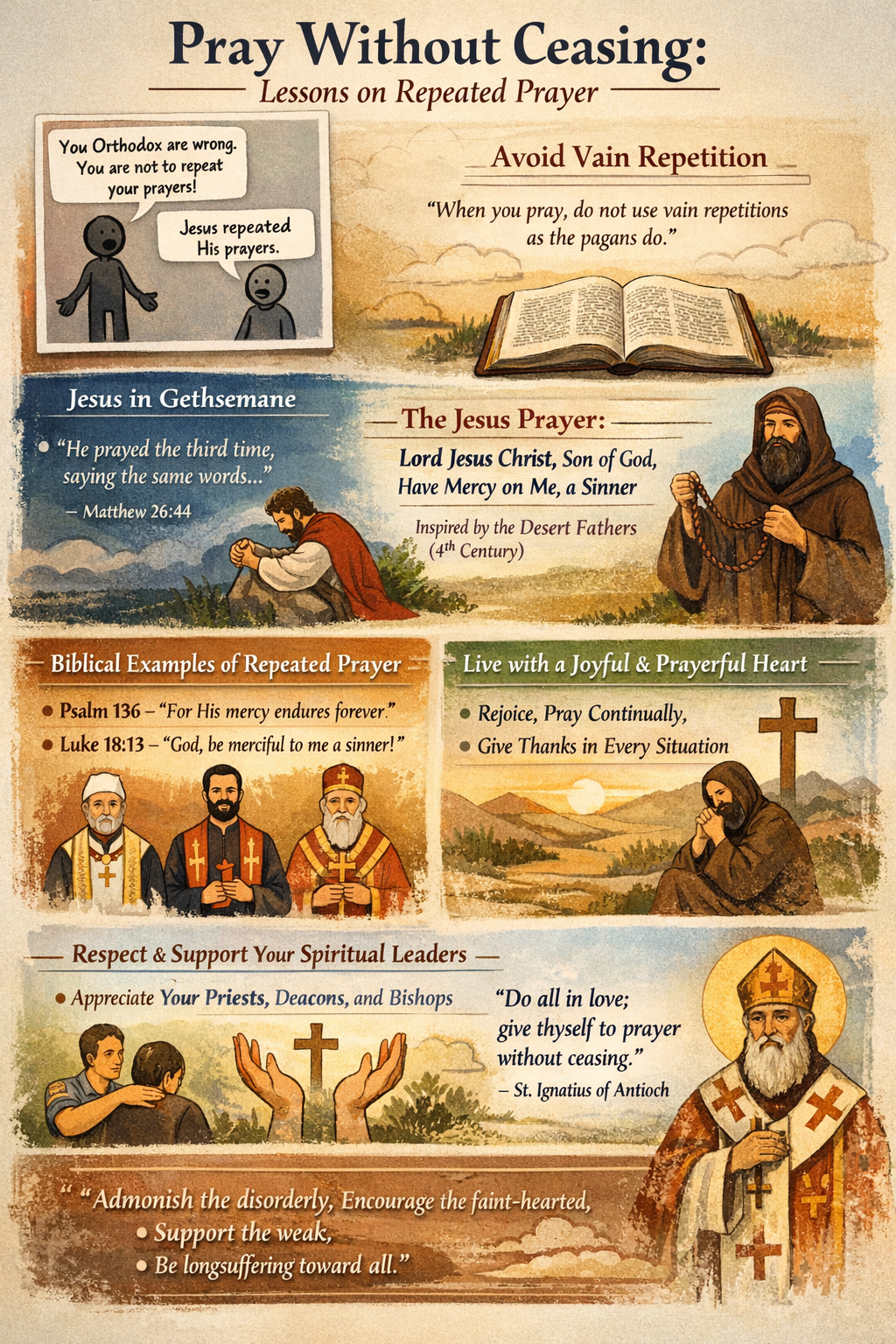
St. Paul says, ‘Pray without ceasing.’ I recently saw a meme on Facebook that reminded me of what we were discussing earlier. On the left side, one person says, ‘You Orthodox are wrong. You are not to repeat your prayers.’ The other replies, ‘Jesus repeated His prayers.’ That response is important. Why would someone say Orthodox Christians are wrong for repeating prayers? Usually, the objection comes from Matthew 6:7, where Scripture tells us to avoid vain repetition. But vain repetition does not simply mean repeating a prayer. It refers to empty, mindless babbling, like the pagan style of prayer in which people kept multiplying words as though they could force a god to listen.
Orthodox Christians are often accused of using “rote prayer,” as though our liturgy were just mechanical repetition or empty phrases. But that is not what is happening in the Holy Qurbono. Yes, the liturgy remains consistent from week to week, and that consistency is part of its beauty. But these are not meaningless words. They are living prayers lifted up to the Lord every single Sunday. So we really must push back against the idea that repetition automatically makes prayer empty.
In fact, Christ Himself repeated His prayer. In the Garden of Gethsemane, right before His arrest and crucifixion, He prayed, ‘O my Father, if this cup may not pass away from me, except I drink it, thy will be done.’ Then He returned and found the disciples asleep. He went away again and prayed the third time, as Scripture says, ‘saying the same words.’ So at the most intense and sorrowful moment before His Passion, Jesus repeated His prayer. That alone shows us that repetition itself is not the problem. Empty repetition is the problem.
There are many biblical examples of repeated prayer. In Psalm 136, certain phrases are repeated again and again. In Luke 18:13, the tax collector repeatedly cries out, ‘God, be merciful to me, a sinner.’ This can even be seen as an early form of what later became the Jesus Prayer: ‘Lord Jesus Christ, Son of God, have mercy on me, a sinner,’ or in its shorter form, ‘Lord Jesus Christ, have mercy on me.’
That prayer tradition became especially associated with the Desert Fathers in the fourth century. These early monks, living in the desert, began praying this prayer constantly. They were not inventing something without biblical basis. Rather, they were drawing from patterns already present in Scripture. Over time, they began to practice it more methodically. At first, they would count prayers by dropping little pebbles into a bowl. A spiritual father might instruct someone to pray 300 or even 1,000 Jesus Prayers in a day. But they quickly realized they could not easily work while counting with stones, so the prayer rope developed as a practical tool. Its purpose is simple: to help the mind and heart return again and again to prayer throughout the day—‘Lord Jesus Christ, have mercy on me.’
This is something still seen very clearly in monastic life. I once watched a documentary on the monks of Mount Athos, and the same thing appears there as in monasteries here: the monks are continually praying, even while doing ordinary tasks. Some of you met my spiritual father, who is a Coptic Orthodox monk, when he visited me here in the United States. When I speak to him on the phone, sometimes he will say, “Hold on, I need to get a book,” and as he walks away, I hear him quietly praying, ‘Lord Jesus Christ, have mercy on me,’ sometimes in German, sometimes in Arabic. This is deeply common in the monastic world, but it is also something beautiful and practical for all of us.
So what can we take away from this passage? One of the first questions we should ask is this: How can we show respect and support for the people who guide and teach us in the faith? How do we show respect to Abuna? How do we support our deacons, who read the Scriptures to us? How do we appreciate those who expound the Word of God, explain the lives of the saints, and help us understand feast days and teachings of the Church?
It is always interesting to see how different Orthodox traditions express reverence. In my husband’s Greek Orthodox church, for example, when greeting a priest, I hold out my hand and wait for him to place his hand there so that I may kiss it and receive his blessing. The first time I tried to do that with Abuna Abdul Mesi—Dimma’s father—he kind of pulled away, and I thought, “What am I doing wrong?” But in the Syriac Church, and also in the Coptic Church, there is often more distance in that gesture. The priest still gives a blessing, but he also expresses humility, as if to say, “I am only a servant of God.” So I always tease Dimma’s dad a little when he pulls away. One of these days, I joke, I will make him let me do it.
Another question from this passage is: Which of St. Paul’s instructions is hardest for us right now? Is it rejoicing always? Praying constantly? Giving thanks in all situations? And then we should ask: why is that hard for us? That kind of honest reflection helps us see where we most need God’s grace.
A third question is this: How can we bring peace and encouragement to someone in our church, school, or family this week? I love one example I recently saw in my husband’s church. The women’s group had put up a “gratitude tree” for the period leading up to Easter. You take a slip of paper from the tree, and it gives you a small act of encouragement to do—perhaps writing a note to someone in the parish or calling a person you have not spoken to in a long time. These simple actions become ways of bringing joy, peace, and encouragement to others.
Now, moving into the witness of early Christian writers, I want to mention The Shepherd of Hermas. This is not part of the Bible, but it was a very influential Christian writing from the second century. It was widely read in the early Church because it gave practical encouragement about repentance, ethics, and Christian living. One passage says: ‘How will you instruct the elect of the Lord if you yourselves have no instruction? Instruct each other, therefore, and be at peace among yourselves.’ That echoes what St. Paul is saying: help one another understand the faith, and live in peace.
Then we have St. John Chrysostom, the great bishop who died in 407 and whose name means “golden-mouthed.” He says something very striking. If we decide that we will hate ungodly or lawless people, then sooner or later we will end up hating sinners. And if we hate sinners, we will find ourselves cut off from nearly everyone—because no one is without sin, including ourselves. He says that if we were truly to hate all who fall short, we would become worse than wild beasts, full of pride and isolated from everyone. Instead, St. Paul teaches us something entirely different: ‘Admonish the disorderly, encourage the faint-hearted, support the weak, be long-suffering toward all.’
Abba Poemen, one of the Desert Fathers, gives a very practical explanation of what it means not to repay evil for evil. He says that the passions work in four stages: first in the heart, then in the face, then in words, and finally in actions. In other words, something begins internally, then it shows itself outwardly, then it becomes speech, and eventually it may become harmful action. So he says that if you can purify the heart, you can stop it there. If it has already reached your face, then at least be careful not to speak. And if you do begin to speak, stop the conversation before it turns into evil for evil. This is where the Jesus Prayer becomes so helpful. If I stop and say, ‘Lord Jesus Christ, have mercy on me, a sinner,’ I am reminded that while the other person may be wrong, I too am a sinner in need of mercy.
St. John Chrysostom says something similar in another passage. He imagines someone saying, “This man is bad. He has wronged me. He has injured me.” And the response he gives is remarkable: do you want revenge? Then do not retaliate. But even that is not enough. The higher Christian calling is not merely to refrain from evil, but to actively do good in return. Not only not to repay evil with evil, but to answer evil with good. That overturns the logic of the world.
This reminds me of something my spiritual father once told me, drawing from the Church Fathers. When someone offends him, he may apologize to that person even if he himself was the one offended. He will say, “I am sorry that I caused you to feel that way.” Why? Because it punctures the anger in the conversation. It lets the air out of the conflict. The other person suddenly realizes, “This person is treating me kindly, even though I was being harsh.” In that moment, kindness becomes stronger than retaliation.
Then there is St. Ignatius of Antioch, one of our most beloved early fathers, who died around AD 108 and was martyred in Rome. He says, ‘Do all in love, as also thou doest; give thyself to prayer without ceasing.’ Love and prayer belong together. Prayer keeps the heart in the right condition so that love can be expressed.
As we come toward the end, what can we learn from all this? First, we are called to respect and support our spiritual leaders. Certainly, there have been tragic times in the history of the Church when spiritual leaders have failed badly or even abused others. That is real, and it must be acknowledged. But that is not the subject here. Here we are speaking about our priests, deacons, bishops, and all those who faithfully labor for the Lord. They deserve our respect, support, and prayers. When Sayidna comes to visit our church, for example, we should make a point of thanking him for his labor, for making it possible for us to have a church, a priest, and worship on Sundays.
Second, we are called to live with a joyful and prayerful heart. We are encouraged not necessarily to be happy all the time, but to rejoice in Christ, to pray continually, and to give thanks in every circumstance. This is something we can begin practicing immediately. Thank the Lord throughout the day. Return to prayer whenever you remember. Over time, this becomes a habit. And when you forget, simply begin again. That is one of the beautiful truths of Christianity: when we fall, we get back up. The demons fell and never rose again. But we, by the mercy of God, can rise and continue walking toward Christ.
Third, we are called to encourage and care for others. We should be patient with those around us, help those who are struggling, and become peacemakers in our communities. If we see conflict, we should try to calm it rather than inflame it. We should seek to be the kind of loving presence Christ calls us to be. Yes, we get tired. Yes, we get irritable. Yes, sometimes hunger, stress, or frustration affect our behavior. But in those moments we must step back and ask ourselves whether we are reflecting Christ in the way we speak and act.
That is really what St. Paul is teaching us here. He is telling us to keep our eyes fixed on Christ. We are not to become consumed with speculation about when He will return. Rather, we are to live faithfully now. If we keep our eyes on Christ, we will walk a straight path. If we fix our eyes only on human beings, they will inevitably disappoint us at some point. But if we follow Christ—and live out these principles of peace, encouragement, prayer, and patience—we will become people who strengthen others.
So that is what I had for tonight. Any questions from you all?
Contact
Reach out for spiritual guidance or questions
Email : vicar@stpetersphoenix.org
© 2025. All rights reserved.