Sermon - Fourth Wednesday
Sermon - Fourth Wednesday
3/10/20266 min read
Beloved in Christ,
Peace and tranquility be with you all.
On this Fourth Wednesday of the Great Lent, the Holy Church gives us a Gospel reading so rich that every line invites us to pause, to tremble, and to worship. It begins with a simple scene: halfway through the feast, our Lord Jesus Christ goes up to the Temple and teaches. The people marvel and ask, “How does this man know the Scriptures without having studied?” They were looking at Him through the eyes of the world—degrees, institutions, credentials. But Christ’s authority does not come from human classrooms. He is not merely a student of the Word—He is the Word. He speaks Scripture as One who authored it, fulfills it, and embodies it. And here is the first Lenten meditation: the deepest truths of God do not yield to pride and display; they are revealed to those who stand before Him with humility, awe, and hunger.
Then the Lord takes us higher than the Temple itself: “No one has ascended into heaven except the Son of Man, who is in heaven and who descended from heaven.” In one sentence He declares the whole mystery of our salvation. Humanity could not climb into heaven by its own strength. We could not reason our way up. We could not improve our way up. We could not conquer death and corruption. So heaven came down. The Son descended. And this is the purpose of the Incarnation: the true God became man, so that man may be lifted up to God. This is not poetry; it is the very engine of redemption. When we sing the Nadha Deva hymn, that second chant is not just beautiful—it is foundational: to make us sons of God in heaven, He became one among us. Orthodoxy is not merely about being “correct.” Orthodoxy is about this living miracle—God entering our condition to elevate us into His life.
When we speak of this, beloved, I cannot avoid a personal testimony. When I was enthroned, I did not fully grasp the weight of the name that was given to me. Later, when I came to know the great Patriarch Alexandriyos of Alexandria, my heart was shaken. He was a shepherd who would not compromise truth, and he gifted the Church a treasure beyond price—his deacon, his disciple, his successor: Mor Athanasiyos. That Athanasiyos stood like a pillar against Arius, and by God’s grace he helped secure the confession of the Son as homoousios—of one essence with the Father—so that Christianity itself would not be reduced to a moral system, but remain what it truly is: the revelation of the living God. Once you begin to learn the lives behind the names we inherit, it is impossible to remain casual. You cannot be proud in the worldly way—you become afraid in the holy way, because you realize that names in the Church are not ornaments; they are crowns.
And Mor Athanasiyos, that Patriarch of Alexandria, wrote a book that every Christian should taste at least once: On the Incarnation of the Word. There, he speaks with crystal clarity: the Incarnation is not a temporary visit; it is God’s decisive act to heal our nature and restore our destiny. Our Church’s Christological confession is rooted in this Incarnational theology. The Word truly became flesh—not in appearance, not in symbolism—so that He could truly heal what He assumed, and truly raise what He united to Himself. We are not saved by ideas. We are saved by union—by participation in the life of God through the God-man, Jesus Christ.
Then the Gospel gives us a second image, and the Church wants us to stare at it without underestimating it: “Just as Moses lifted up the bronze serpent in the wilderness, so must the Son of Man be lifted up.” In the wilderness, people were being bitten; death was spreading; suffering was real. And God, who is kind, acted. He gave Moses wisdom—not merely to explain suffering, but to alter the situation and heal the people. When the bronze serpent was lifted up, those who looked were healed—not because bronze has power, but because God used a lifted sign to pour mercy into a dying camp. Now Christ says: that was only a shadow. The true lifting is the Cross. The wilderness was temporary; the world is the wilderness now. The serpent’s bite was physical; sin’s poison is deeper. And therefore the remedy must be greater: the Son of Man must be lifted up, so that whoever believes in Him should not perish but have eternal life.
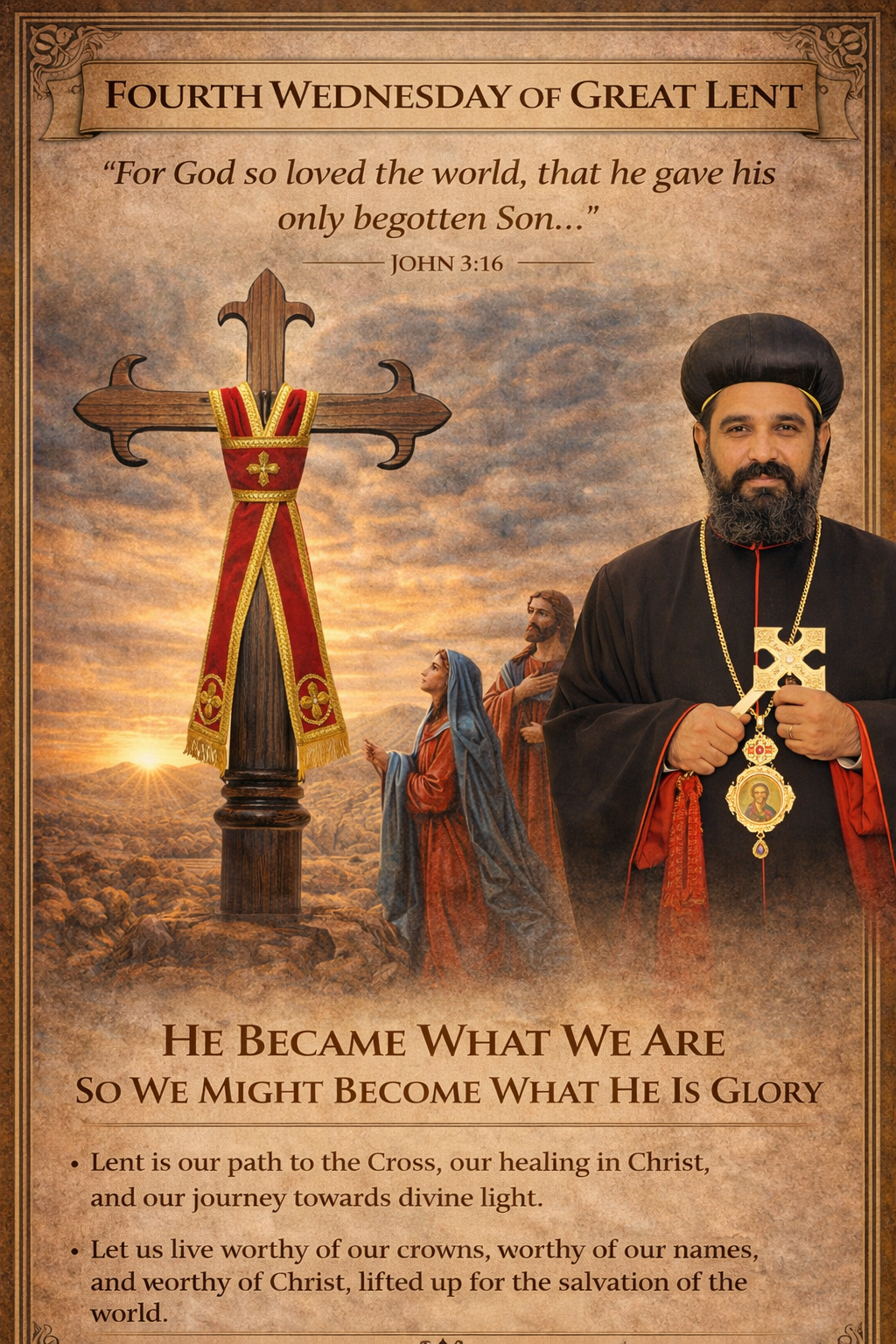
And then comes the verse that is not merely famous—it is the heartbeat of the universe: “For God so loved the world, that He gave His only begotten Son…” Beloved, the Gospel begins not with condemnation but with love. Not with rejection but with giving. The Father did not send the Son as an angry judge hunting sinners; He sent the Son as a saving gift for dying humanity. Lent is therefore not a season of despair. It is the season when we finally admit we are wounded, so that the Physician can heal us. “God did not send His Son into the world to condemn the world, but that the world through Him might be saved.” This is Orthodox Christianity: the Church is not a courtroom for the already-condemned; the Church is a hospital for the dying, a refuge for the weary, a house of restoration.
But the Lord does not allow us to remain vague. He draws a line that cuts through every excuse: “Light has come into the world, but people loved darkness more than light.” This is not merely about atheists “out there.” This is about a spiritual law in every human heart. Darkness is comfortable because it hides. Light is painful at first because it reveals. And this is why Great Lent is so merciful and so severe: it is the Church turning on the light. Not to shame us—God forbid—but to save us. The one who does evil hates the light because light exposes what evil wants to keep secret. But “the one who does the truth comes to the light, so that it may be made manifest that his works have been done in God.” This is repentance: not merely feeling sorry, but stepping into the light voluntarily, allowing Christ to expose, cleanse, and rebuild.
Beloved, we are in the middle days of Lent, and today we place Gogultha in the center. This is not decoration. This is the Church stopping us in our tracks and saying: Look. Here is the lifting of the Son of Man. Here is your healing. Here is your destiny. And there is another meditation we must not neglect: when Gogultha is placed in the middle, it is also a call to remember the name you inherited—the saint or martyr whose name rests upon you like a crown. In Orthodoxy, crowns are given first—at baptism, at matrimony, in the very identity of the Christian life—and then we live a life worthy of the crown. A name is not casual; it is a responsibility. It is a model. It is a summons. It is a promise that you must grow into. If you inherited the name of a saint, then your life must slowly become an echo of that saint’s life, so that in the eternal world you may stand with them, not as a stranger wearing their name, but as a child who learned their path.
Therefore I ask you—and I ask this also for myself—pray for every bishop who bears the names of the Fathers: that we may live worthy of those names, worthy of those crowns, worthy of the Gospel. I must work hard to remain in line with the great Alexandriyos who gifted Athanasiyos. And every one of you must also recognize this spiritual reality: your name is a crown; your faith is a calling; your life is your offering. When you see Gogultha in the center, remember: Christ was lifted up to heal you, and you must now rise to live as a son or daughter of the light.
And here is the final wonder: the purpose of the Incarnation is not only forgiveness. It is elevation. It is transformation. It is divine adoption. It is participation. Christ became what we are, so that we might become—by grace—what He is in glory. And in the Eucharist, this is not a distant theory. It is already being given. We are invited into divine life. We are invited into holy partaking. We are, in a real sense, already crowned—because Christ has already begun His work in us.
So let us come to the light. Let us not love darkness. Let us not hide our wounds. Let us not treat Lent as routine. Let us look to the lifted Son of Man, and let us receive the love of the Father who gave His Only-Begotten Son for the life of the world. Let us live worthy of our crowns, worthy of our names, worthy of the saints, worthy of the Cross placed in our midst. And let the world, through us, experience the glory of God—not through our words alone, but through lives made luminous by Christ.
Beloved in Christ,
Peace and tranquility be with you all.
Amen.
Contact
Reach out for spiritual guidance or questions
Email : vicar@stpetersphoenix.org
© 2025. All rights reserved.